
Your Bike Gets Serviced. When Did You? Why Men Put Off Check-Ups
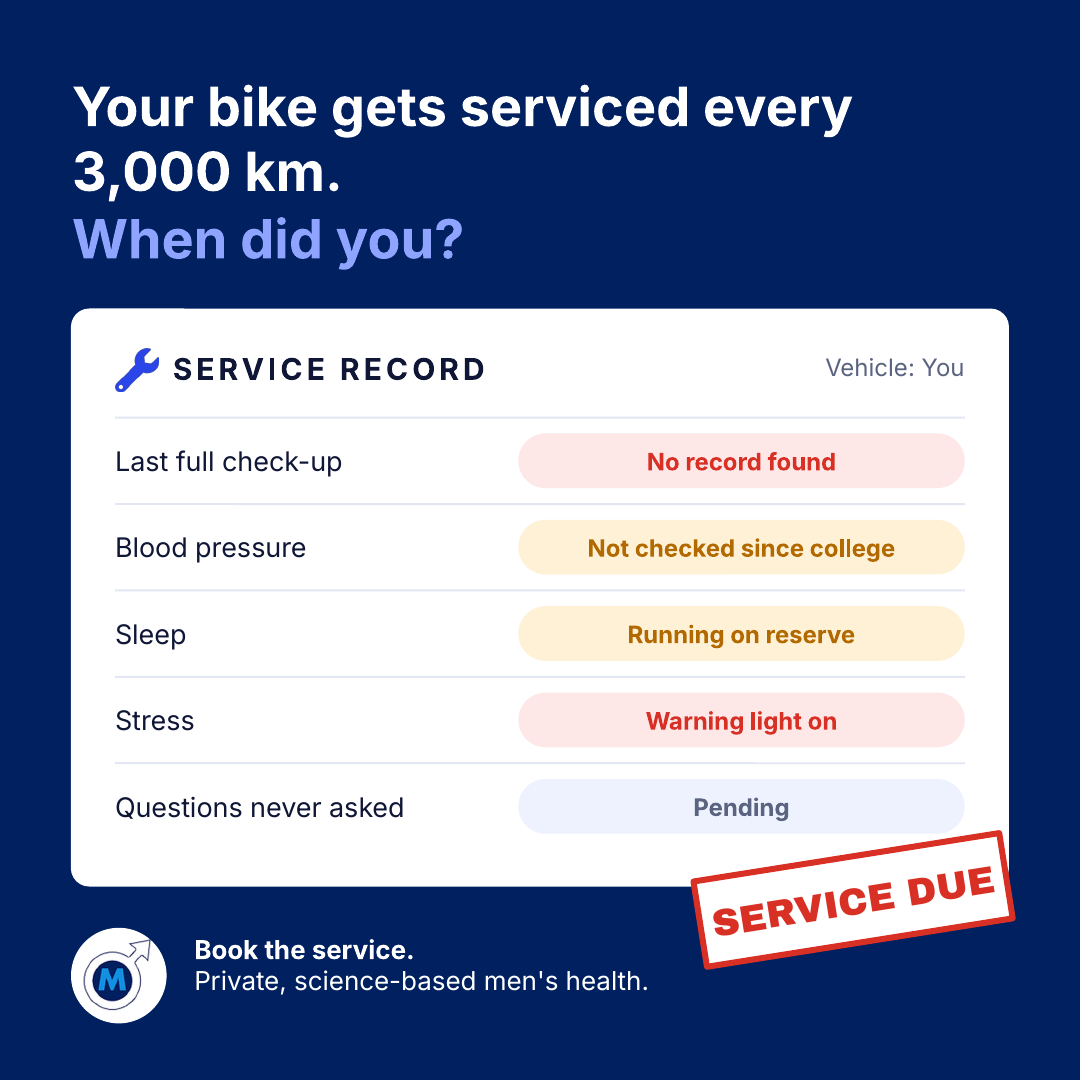
Your bike gets serviced every 3,000 km. Your car goes in every 10,000. Both come with a service book, a reminder sticker and a mechanic who calls when you are late.
Now try filling in the same record for yourself. Last full check-up: no record found. Blood pressure: not checked since college. Sleep: running on reserve. Stress: warning light on. Questions you have never asked: pending.
If that looks familiar, you are not alone. Many men look after their vehicles more carefully than their own health. Here is why that happens, and a few simple ways to change it.
Why men put it off
Nothing feels wrong. A vehicle gets serviced on a schedule, not only when it breaks down. Health check-ups are often treated the other way round: something has to hurt first.
It feels like weakness. Many men grew up hearing "man up" and "walk it off". Booking an appointment without a clear problem can feel like making a fuss.
Some questions feel awkward. Personal and reproductive health topics are hard to raise, even with a doctor. It is easier not to ask, so questions pile up for years.
There is never a good time. Work, family and everything else come first. The check-up stays on the "later" list indefinitely.
Treat it like a service schedule
The vehicle comparison is useful because it removes the drama. Nobody thinks a car is weak for going in for a service. It is just maintenance.
Put a date on it. Pick a month each year for a routine check-up, the same way you remember insurance renewal. A doctor can tell you which checks make sense for your age and history.
Keep your own service book. Note down when you last had a check-up, any test results you were given, and anything you have noticed since. It makes the next appointment faster and more useful.
Do not ignore warning lights. Ongoing tiredness, poor sleep, high stress, or any change in your body that worries you are reasons to talk to a professional, not to wait.
Write down the question you have never asked. Then take it with you. Doctors hear the same questions every day. Yours is very unlikely to be the first.
A private place to start
MenGO is a private, science-based companion for men's personal health. It offers reliable information on topics many men find hard to raise, and access to qualified specialists when you want to take the next step.
Get MenGO on Google Play: https://play.google.com/store/apps/details?id=com.systemonsilicon.mengo
Book the service. Your future self will thank you for keeping the record up to date.
MenGO provides health information and is not a substitute for professional medical advice, diagnosis or treatment. If you have symptoms or concerns, please see a qualified doctor.